Sunday, December 5, 2010

Cormac McCarthy: American Canticles

Quote of the Book:

“Game-faced, quietly wry, country recessive, he’s ever respectful and careful, as the ‘Old Man’ of Taoist China, Lao Tsu, advised men crossing a winter stream”(13).

After reading two of Cormac McCarthy’s novels, this quote and its passage make the reader reconsider Cormac McCarthy. Cormac McCarthy: American Canticles by Kenneth Lincoln is both a short biography of McCarthy’s life and lengthy descriptions of his books. The quote above is describing Cormac McCarthy’s appearance on Oprah. The description from this book about what occurred during the show was very surprising to me while reading. The books I read prior to this memoir showed a writing style that is very rough and pessimistic. In fact, McCarthy is known for this kind of rough and pessimistic writing style. There is no wasted time describing something irrelevant, McCarthy just goes straight to the point and gives the information to the reader in a matter-of-fact form. An example of this, from No Country for Old Men, is when the antagonist kills a bounty hunter. The antagonist shoots his shotgun, picks up the shell of the bullets, cleans it, and puts it in his pocket. This is basically the same amount of description that McCarthy gives, though he is much grimmer. This writing style, I believed while initially reading this passage, does not fit the description of the man described in the quote above. McCarthy is described as relaxed, happy, and slightly withdrawn. This is different than I pictured, which was a gruff man enjoys westerns. Now that I have finished this book and read the analyses of McCarthy’s stories, I can understand that the writing style does fit. The stories are much more than just westerns as I had originally thought. McCarthy is an author that sees the world and tells his view. He has the courage that most authors do not have by displaying the grimmer side of reality in his novels.

Connections:

Because the genre of Cormac McCarthy: American Canticles is non-fiction/biography there are so many connections to the real world. Also, something unique about this book is that this novel even describes the connections from McCarthy’s books to the real world. One connection that I find interesting is just Cormac McCarthy to reality. While reading the two novels by Cormac McCarthy, I thought he would have to be one of the most out-of-reality people that live on this earth. I was wrong. Cormac McCarthy just seems like a regular person, which was surprising to me, with a couple qualities that allow him to write the novels he writes. These qualities include courage and humility. I do not know if I could write such a bleak description of the human race, even if I thought it was true.

A second connection that I find is between McCarthy’s books, as described in this novel, and the real world. During the biography portion of this novel, the reader learns that McCarthy thinks the same of the Old West as others believe of some magical world described in Science Fiction or Fantasy novels. McCarthy’s stories are set in the Southwest. Though there is a physical connection to the real world through these settings, there is also a moral connection. Each of McCarthy’s stories has a moral value that is consistent throughout the book. These moral connections talk about human failings and hardships and what people can do to overcome them. Though it sometimes does not end well for the characters in the stories, these connections can easily teach readers extremely important values.

The last connection I found with this novel is with me personally. I have now realized that I can somehow connect with Cormac McCarthy. I have found that I am analytical, a quality that I now see in Cormac McCarthy. McCarthy views the world through a mind that thinks before it acts. It is obvious that McCarthy has developed the ideas that he has instilled within his novels. I believe that I too view the world and then think before I act. I do not like to be irrationally impulsive. Every one of McCarthy’s novels displays this kind of ideal and how it can fail or succeed. I just find it interesting that I can somehow connect with Cormac McCarthy and his books.


Visual Representation
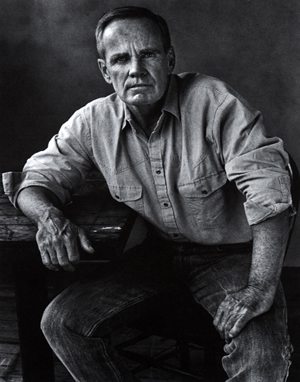
The picture above is of Cormac McCarthy. I chose this picture for several reasons, the first being obvious; seeing as this novel is a biography there is no better way to depict the novel than a picture of the person who the book is about. The second reason why I chose this picture is because it shows McCarthy with a rough exterior, enhanced by the grayscale color. After reading Cormac McCarthy: American Canticles I see through this rough exterior. I find that McCarthy is much more analytical than when I first read his books. One last reason why I chose this picture is because it shows how McCarthy wants to be seen. It is very simple, and yet it shows a man that has so many dimensions to him. To someone who has not learned about Cormac McCarthy, this picture would be meaningless, just an older man in regular clothes. However, to a person who is learned about Cormac McCarthy, this picture shows so much more.

Questions:

1. Could you reveal your true thoughts on reality, even if they were somewhat bleak, to millions of people?

2. Should an author make it hard for a reader to understand the core moral of the story?

3. Should authors follow general grammatical conventions?

4. Should life be lived in the past, present, or future?

5. If you could, would you fix your mistakes?

Reflection:

Cormac McCarthy: American Canticles is one of the hardest novels I have ever had to read. It is dry and every twenty minutes felt like an hour. However, getting through the book was a whole other story. This book taught me many important things about an author I did not fully understand. After reading the first two books by Cormac McCarthy, No Country for Old Men and All the Pretty Horses I felt like I just could not handle the writing style. This book changed my outlook on McCarthy. I now find his books extremely insightful; in fact the two books I read by him are now a lot clearer to me and I consider them extremely well written novels. I still however hold by the fact that McCarthy should use quotes when characters speak, but the story and the moral of his books are much more important. I do suggest reading Cormac McCarthy: American Canticles for those unsure about Cormac McCarthy, however reading this book is extremely difficult. For me, it was definitely worth this dry novel to learn about Cormac McCarthy.

Thursday, November 4, 2010

All the Pretty Horses

Quote of the Book:

“You want to flip to see who gets to shoot him? (Rawlins)

Yeah. Go ahead. (John Grady)

Call it, said Rawlins

Heads. (John Grady)

The coin spun in the air. Rawlins caught it and slapped it down on the top of his wrist and held his wrist where they could see it and lifted his hand away.

Heads, He said.

Let me have your rifle.(John Grady)

It ain’t fair, said Rawlins. You shot the last three.

… You all are just funning, said the boy. (Blevins)

What makes you so sure? (Rawlins)

You ain’t shot nobody. (Blevins)

What makes you think you wouldn’t be somebody good to start with (Rawlins)” (41).

In All the Pretty Horses by Cormac McCarthy, like most of his books, there is not really a central quote because of McCarthy’s writing style. McCarthy’s style is very abrupt and throws away all conventional grammar. It says what is happening and then moves on. In this novel, it is the same. There is no central quote because there is nothing really central in McCarthy’s novels. The quote I chose, though long, displays several main ideas in McCarthy’s writings and it talks about the characters themselves. From the books I have read by McCarthy, and from what other people say, I have found that the characters in McCarthy’s books are just as rough as his writing style. As one can see in the quote above, the dialogue is very sarcastic and to the point. This seems to be a common theme throughout many of his books. The characters and the books are all very hard and sarcastic.

This quote is central to the book because it shows not only the characteristics of Lacey Rawlins and John Grady Cole, but also the addition of Jimmy Blevins to the group, the boy in the quote above. It shows that Rawlins is the more talkative of the two sixteen year olds, while John Grady seems to watch events unfold and place his input at opportune moments. It also shows the lack of gullibility of this thirteen year old boy, Jimmy Blevins. This quote reveals many ideas about McCarthy’s abrupt writing style and allows the reader to learn more about the characters. In this quote, it shows that the setting of the book produces young people that have a certain hardness to them that makes them seem more like adults rather than children and that there is still certain softness within them. An example of this is when John Grady learns of his father’s death later in the story. This is a huge part of the story because it shows John Grady crying for a man he barely knew. It shows the kindness within these hard characters, that they are actually people behind a hard exterior.

Connections:

There many connections to the real world throughout this story. The first one is the setting. The setting is on the real world southern United States in 1949-1950. The fact that Cormac McCarthy sets the setting an area that many people have imagined, a place and time when cowboys roamed, gives the story a certain excitement. Not only that, but the story is realistic. This setting is not only imagination because the places where the book takes place were real sixty years ago. This reality makes the story much more interesting. Another connection to the real world is the people. The people in this novel, though they experience extraordinary things, are still people. A reader can relate to this kind of character because he/she can imagine him/herself in the shoes of this relatable character. Also, these characters are not perfect. In fact, McCarthy seems to completely understand human nature because it is so easy for the reader to connect with the characters. They experience very real things and display very real emotions that the reader cannot help but relate to. Another connection to the real world is the plot itself. It shows everything needed in a good book, a conflict, romantic interest, and action, all wrapped up in a bundle of reality. Everything that occurs in this novel is something that can happen to a real person reading the book. These experiences also make the characters have real feelings, allowing the reader to fully connect with the book.

All of the connections in the book intertwine to one idea; the story is something that could easily have been reality. McCarthy uses this idea to connect with readers and is successful in doing so. The connections to the real world are throughout the book, so it is not hard to use imagination and visualize the story unfold.

Visual Representation:

This novel has a common theme that is displayed throughout the book; freedom and its consequences. When looking for a picture that would represent this novel, I was not sure where to start. When I typed in freedom and found the picture above, I knew exactly what I wanted to write about. The picture above shows freedom and its price. In the background of the picture are the Statue of Liberty, the American flag, an eagle, and many other symbols of freedom in the United States. In the front of the picture the price for the background is shown. In All the Pretty Horses the boys find that they love their newfound freedom. Rawlins even states that he loves the new life while he and John Grady were smoking by a fire out in the country. Then later, when John Grady and Rawlins find a farm and work, and John Grady finds the girl he loves, they still love their freedom and the new good things in their lives. This freedom, the thing that John Grady, Rawlins, and even Blevins treasure most, ends up coming at a terrible cost. John Grady, Rawlins, and Blevins are inevitably jailed and experience terrible things, the first of which being the execution of Blevins. Later, John Grady and Rawlins are both injured, but they eventually get out of the jail. This experience changes the two characters, making Rawlins want to give up his freedom and go back home and making John Grady desire for what he had previously to being jailed. The costs for their freedom leave permanent scars on the characters in this book. This picture above represents this idea by the death of troops that attain our freedom.

Questions:

1. Why does Cormac McCarthy disregard common grammar usage? (his writing style could still be seen if he had quotation marks)

2. Do the ends justify the means?

3. Is a higher risk worth it when trying to attain a greater goal?

4. Is it good to let desires take over logical thinking?

5. If you had the chance, would you leave without looking back?

Reflection:

All the Pretty Horses is a book with a story that is completely unexpected and very gripping on the reader. While reading this novel, I still had trouble deciphering all that was written, even after reading another book by Cormac McCarthy. After reading this story I do respect his writing much more because of his incredible stories, but his writing style is a bit too much for me. I do enjoy the roughness of his writing because it matches the storyline, making the book much better, but the lack of conventional grammar can become extremely frustrating. One of the main problems with grammar that McCarthy seems to have is a lack of a desire to use quotation marks during dialogue. If this story, and his other stories, just had quotation marks, his books would be so much better. Quotation marks are not a writing style; they give a certain organization that allows the reader to understand the story. Without quotation marks it is extremely easy for a reader to miss something very important without knowing it. This is really my only complaint about this book. The story is very good and I think that McCarthy’s writing style of matching the story gives the book a feel of authenticity. His lack of conventional grammar is just very frustrating.

Thursday, October 7, 2010

No Country for Old Men by Cormac McCarthy

Quote of the Book:
"He'd felt like this before but not in a long time and when he said that, the he knew what it was. It was defeat. It was being beaten. More bitter to him than death"(307).
Throughout the novel No Country for Old Men there is this common theme of defeat. This quote gives a general idea of the book. Throughout the story each person is striving to succeed; the thought of defeat never even crossed their minds. This is where the theme of defeat comes into play. In this story, there is really not much success. Most of the characters inevitably fail what they are trying to do. In the quote above, their feelings are summed. None of them thought of the possibility of not succeeding, and when they are defeated death is preferable.

Connections:
This book holds many connections to the real world. It is a fictional story, but it is written in a real world setting. This is the first obvious connection. This story is set in the early 1900s in southern United States. The people are callous and extremely brief with one another. Most answers to questions are one word answers and conversations only last a moment.
A second connection to the real world would be the common theme of most people's desires; money. This whole story is started because of a bag of money. When an unsuspecting man walks down the road, he spots the remains of a fight. He moves on and finds a dead man clutching a bag full of money. The character finding the bag of money is the start of the entire story.
One last connection that the author makes is to the reader themselves. Many authors try to show the emotion of the characters to connect to the reader. but Cormac McCarthy goes out of his way to make sure that the characters have similarities to real people. One example is an experience of a police officer. To learn about this character, McCarthy has the reader find out, from a chapter with almost no cohesion with the rest of the book, the mindset of the officer. McCarthy is very successful at this kind of writing. It is extremely unconventional and allows the reader to connect with the characters.

Visual Representation: I chose this image because it represents what the story is about. One of the main themes of this story is danger. Throughout the entire story, it seems as if each character has an axe raised above their heads with a block under their chin. The story is very suspenseful in this way, and gives the reader a constant idea of danger. For example, one of the characters, the main antagonist, is a killer who makes sure anyone who knows about him has an axe ready to fall above their heads. At one point he states, "You're asking that I make myself vulnerable and that I can never do. I have only one way to live. It doesnt allow for special cases"(259). At this point, the antagonist is speaking to a girl he is about to kill. This is the only reason he kills those around him; he does not allow himself to become vulnerable. This idea is displayed throughout the book. Everyone is always in danger and there is always this axe suspended above their heads.

Questions:
  1. Why does McCarthy write the way he does? (No quotation marks and no regard for common grammar)
  2. Is the reward worth the risk? In this case is the money worth the constant danger?
  3. Is the safest way to live to crush one's own vulnerabilities?
  4. One of the main characters had previously had to leave incapacitated troops to die in war in order to survive and is angered at himself for leaving them. Should he be angry with himself? Should he have stayed and died with his other troops?
  5. If you found a bag of money on the road, what would you do?
Reflection:
No Country for Old Men
by Cormac McCarthy is one of the most, if not the most, peculiar books I have ever read. Something that bothered me was his writing style. There are no quotes, which seems absolutely pretentious, and the grammar is completely unconventional. In fact, I would most likely receive an F on a paper if I wrote in the grammatical style of Cormac McCarthy. Nonetheless, I was drawn into the story. The way that McCarthy wrote was extremely confusing, but it seemed authentic to the story. His writing style is rough and abrupt, which matches the actual plot. Honestly, I would suggest that people read this book, but they should not start reading with any predetermined ideas on it. I have never read anything like this book, but in some peculiar way I liked it.